
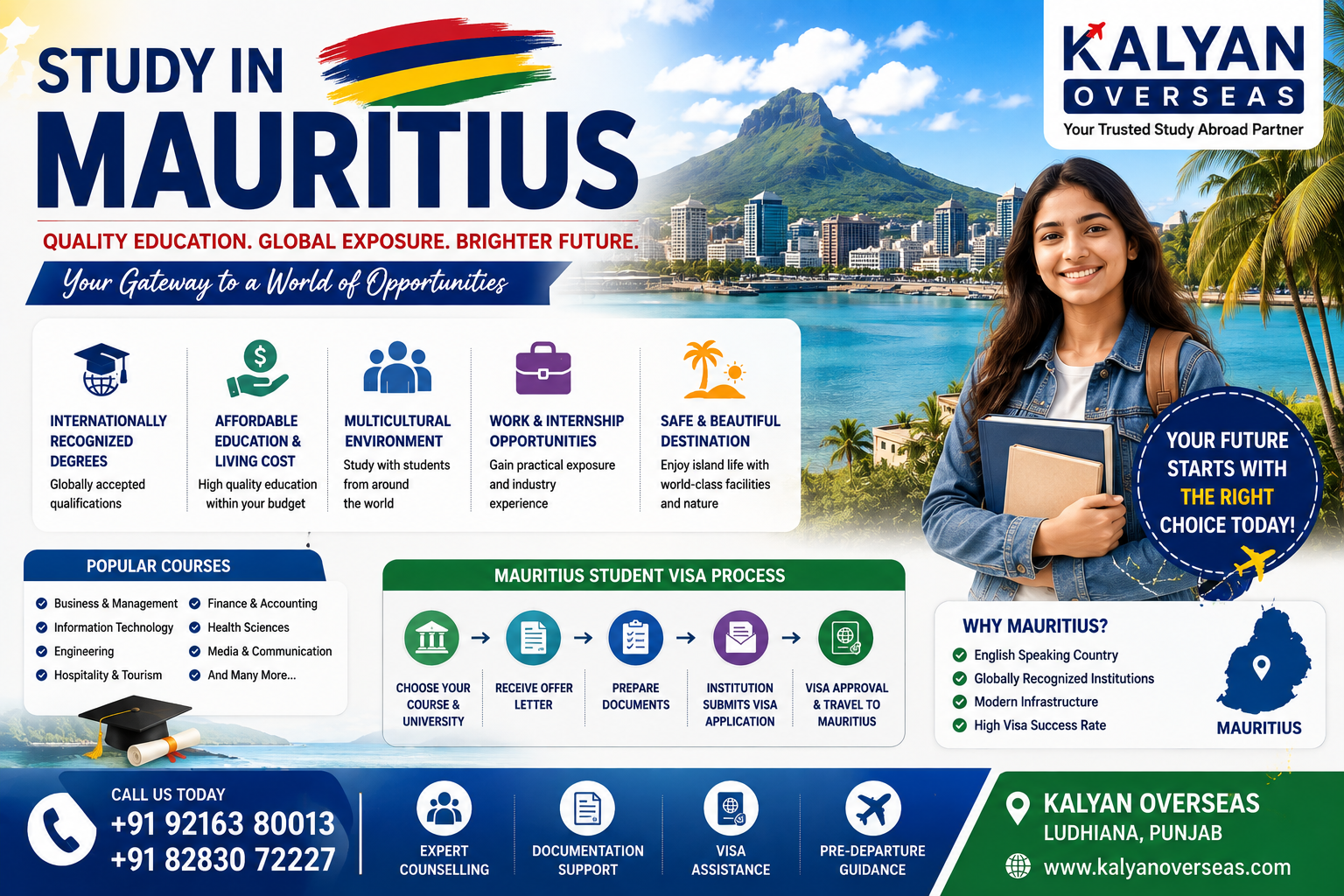
Mauritius Study Visa 2026: A Complete Planning Guide for Indian Students
Mauritius Study Visa 2026: A Complete Planning Guide for Indian Students
Thinking about studying in Mauritius? For Indian students, choosing Mauritius is not simply about finding an international destination with lower study costs. The real question is whether the course, institution, budget, accommodation, visa documentation and long-term career plan work together.
Mauritius has developed a dedicated higher-education ecosystem for international students, with recognised institutions offering programmes ranging from diplomas to doctoral-level qualifications. The official Mauritius Higher Education Desk also provides information on institutions, courses, accommodation, scholarships, student welfare and visa procedures.
If you are exploring Mauritius study visa options from India, Punjab or Ludhiana, this guide will help you understand the process before you make an application.
Why Are Indian Students Considering Mauritius for Higher Education?
Mauritius is increasingly positioning itself as a regional higher-education and knowledge hub rather than simply a tourist destination.
The country's official higher-education platform highlights a mix of public and private institutions, programmes from diploma through doctoral level, campus facilities, work-placement opportunities and an international student environment.
For a student comparing overseas destinations, Mauritius can be worth considering when the priority is:
- International exposure
- A diverse academic environment
- English-based education options
- Access to undergraduate and postgraduate programmes
- Practical learning and placement opportunities
- A comparatively manageable living environment
- Studying in a multicultural island nation
However, students should select an institution and course based on recognition, accreditation, curriculum and career relevance, rather than choosing Mauritius solely because it appears affordable.
Is Mauritius a Good Study Destination for Indian Students?
It can be a suitable option for students whose academic and career plans match the programmes available at recognised Mauritian institutions.
The official Higher Education Mauritius platform states that the country hosts 10 public and 40 private higher education institutions, with programmes covering diploma through doctoral qualifications.
Another important point is language. English is an official language in Mauritius, while French is also widely spoken, creating a multilingual environment for international students.
For Indian students, the right question is therefore not:
“Is Mauritius easy?”
A better question is:
“Does the Mauritius course I am choosing provide the academic and professional value I need?”
That distinction can help students make a much better study-abroad decision.
What Can You Study in Mauritius?
Mauritian higher education covers multiple qualification levels, including:
- Diploma programmes
- Undergraduate degrees
- Postgraduate programmes
- Master's programmes
- MPhil programmes
- Doctoral programmes
- Selected professional and technical programmes
The official Student Visa guidance specifically recognises eligible certificate/diploma programmes, undergraduate degrees, postgraduate study, post-doctoral research and certain exchange programmes at recognised institutions.
Depending on the institution, students may find opportunities across areas such as:
Business & Management
- Business Administration
- Management
- Finance
- Accounting
- Marketing
Computing & Technology
- Information Technology
- Computer-related programmes
- Data and digital fields
Engineering
- Engineering and technical disciplines
- Applied technology programmes
Health & Life Sciences
- Health-related programmes
- Life sciences
Hospitality & Tourism
- Tourism
- Hospitality
- Related service-sector programmes
The exact availability, entry requirements and recognition of individual programmes should always be confirmed with the institution before applying.
Mauritius Study Visa: Who Is Eligible?
Mauritius provides a Student Visa route for eligible non-citizens studying at recognised tertiary or TVET institutions.
According to the Passport and Immigration Office, eligible categories include students undertaking:
- Eligible certificate or diploma programmes of at least one academic year
- Undergraduate degree programmes
- Postgraduate programmes including Master's, MPhil and Doctoral study
- Post-doctoral research
- Certain exchange programmes of up to one year
The institution must be appropriately recognised, and students should confirm that the programme they select meets the relevant requirements before proceeding.
One Important Difference: Your University Plays a Major Role
A common mistake is to think of the Mauritius Student Visa as something the student independently arranges from start to finish.
The current official guidance states that the tertiary or TVET institution where the student is enrolled submits the Student Visa application to the Passport and Immigration Office.
That means your admission process and visa process are closely connected.
Your university or institution may therefore play an important role in:
- Confirming your admission
- Providing course information
- Supplying required institutional documentation
- Supporting the Student Visa application
- Communicating relevant details to the immigration authorities
This makes choosing a properly recognised institution particularly important.
Mauritius Student Visa Documents
The exact document requirements can vary according to your situation, but the official Student Visa guidance currently lists documents including:
- Completed Application to Enter Mauritius form
- Recent passport-size photographs
- Passport biodata pages
- Admission letter from a recognised institution
- Offer letter
- Acceptance letter
- Institutional covering letter
- Course duration and start-date information
- Confirmation regarding the course's full-time or part-time status
- Programme accreditation documentation
- Evidence of financial capacity
- Accommodation documentation
- Medical documentation
Financial evidence can include recent bank statements and, where applicable, sponsorship documentation from parents or guardians.
Important
Do not prepare your documents from a random checklist found online.
Immigration requirements can change, and your institution may request additional documentation.
How Much Money Do You Need for Mauritius?
There is no single universal “Mauritius study visa bank balance” that should be copied from one student's application to another.
The official requirements focus on demonstrating financial capacity to meet the costs of study and stay in Mauritius. The Student Visa guidance refers to recent financial evidence and sponsorship documentation where applicable.
Your financial planning should therefore cover:
Tuition
Consider:
- Course fees
- Registration charges
- Examination fees
- Other institutional charges
Accommodation
Plan for:
- Rent
- Deposit
- Utilities
- Internet
- Food
Personal Expenses
Include:
- Transportation
- Study materials
- Mobile communication
- Insurance
- Daily expenses
- Emergency funds
Rather than showing funds simply because a consultant tells you to, prepare a financial plan that genuinely explains how your education and living expenses will be supported.
Accommodation for International Students in Mauritius
Accommodation should be considered before travelling, not after landing.
The official Higher Education Mauritius platform provides information about accommodation options and emphasises the importance of safe and suitable student housing.
When comparing accommodation, look beyond the monthly rent.
Check:
- Distance from campus
- Transport availability
- Furnishing
- Utility costs
- Internet access
- Security
- Food arrangements
- Contract terms
- Deposit requirements
For an international student, a slightly more expensive location near campus can sometimes be more practical than choosing the cheapest accommodation far away.
Cost of Living in Mauritius for Students
Your actual monthly expenditure depends heavily on accommodation, location and lifestyle.
The official Higher Education Mauritius platform currently gives an indicative figure of approximately USD 300–400 per month including accommodation on a cost-sharing basis. However, this should be treated as a general indication rather than a guaranteed budget for every student.
A student should prepare a personal monthly budget covering:
Accommodation + Food + Transport + Communication + Study Materials + Personal Expenses
Mauritius also has an extensive bus network, which can be useful when planning day-to-day student travel.
Do You Need IELTS to Study in Mauritius?
This is one of the questions Indian students frequently ask.
There is no universal answer that applies to every university and every programme.
English is an official language in Mauritius, but admission requirements are determined by the particular institution and programme.
Depending on the institution, students may need to satisfy specific English-language requirements.
Therefore, before taking IELTS, PTE or another English test specifically for Mauritius, check:
- University requirements
- Course requirements
- Previous education language
- Required English level
- Whether alternative English evidence is accepted
This prevents students from spending money on a test that may not be required for their particular admission route.
Do Students Need a Medical Examination?
Medical documentation forms part of the Student Visa requirements.
The official guidance requires a medical certificate confirming that the applicant is not suffering from specified contagious or infectious diseases and provides requirements concerning tests such as HIV, Hepatitis B and chest X-ray.
Students should follow the latest instructions provided by the Mauritian authorities and their institution regarding where and when medical examinations must be completed.
Can You Enter Mauritius on a Tourist Visa and Change to a Student Visa?
Students should not plan their education around entering Mauritius as a tourist first and sorting out study permission later.
The Passport and Immigration Office specifically advises prospective students to travel to Mauritius only after their application for study or training has been approved.
This is an important distinction between:
Visiting Mauritius
and
Travelling to Mauritius for approved education.
If your purpose is study, your immigration planning should be based on the appropriate student route.
Mauritius Student Visa Application Process
A practical way to understand the process is:
1. Evaluate Your Academic Profile
Review:
- Previous qualification
- Academic marks
- English ability
- Study gap, if applicable
- Career objective
- Budget
2. Select Your Course
Choose a programme that matches your academic background and career plans.
3. Check Institution Recognition
Confirm that the institution and programme meet the relevant Mauritian requirements.
4. Apply for Admission
Submit the required academic and personal documents.
5. Receive Your Offer
Review the conditions attached to your admission.
6. Accept Your Place
Complete the institution's acceptance procedure.
7. Prepare Financial & Accommodation Evidence
Arrange the required supporting documentation.
8. Institution Submits the Student Visa Application
The recognised institution submits the Student Visa application to the Passport and Immigration Office.
9. Wait for Approval
Do not make travel plans based solely on an admission offer. Follow the immigration approval requirements.
10. Travel and Complete Post-Arrival Formalities
Once authorised to travel, follow the institution and immigration instructions regarding arrival and student/residence formalities.
What Has Changed in Mauritius in 2026?
This is an important section for a fresh 2026 article.
Mauritius' 2026–27 Budget includes several measures aimed at strengthening the country as an international education and talent destination.
These include plans for:
- A centralised Study in Mauritius portal
- Development of an online Student Visa system
- Increased permitted part-time work during school holidays from 20 to 30 hours per week
- Post-study work opportunities aimed at retaining foreign graduates
- A framework allowing world-class universities to operate in Mauritius with full university status from inception
These are 2026 policy measures/developments, so students should distinguish between announced reforms and rules already fully implemented when making decisions.
That distinction is especially important in immigration-related content.
Is There a Post-Study Opportunity in Mauritius?
Mauritius is actively working to retain international graduates in areas where the country needs skilled talent.
The 2026–27 Budget specifically proposes post-study work opportunities for foreign graduates and highlights sectors connected to the country's skills requirements.
The official Higher Education Mauritius platform also describes post-study work opportunities for international graduates in areas including ICT, Fintech, Artificial Intelligence and Biotechnology.
However, students should not treat this as an automatic PR promise.
Post-study employment, residence and long-term immigration outcomes depend on the applicable rules, occupation, employer and individual circumstances.
Is Mauritius a Good Option for Students Looking for PR?
This is where students need to be careful.
A study visa is not automatically a permanent-residence pathway.
If your primary objective is long-term settlement, compare the immigration rules separately from the education benefits.
A sensible decision framework is:
Course → Skills → Employability → Eligible Work Route → Immigration Options
rather than:
Study Visa → Automatic PR
Mauritius' current policy direction does include efforts to retain skilled foreign graduates, but students should check the latest residence and employment rules before treating Mauritius as a long-term settlement destination.
What Makes Mauritius Different from Other Study Destinations?
Students often compare Mauritius with the UK, Canada, Australia and European destinations.
Instead of asking which country is “best”, compare them according to your personal priorities.
| Factor | What to Check |
|---|---|
| Tuition | Total programme cost |
| Living expenses | Accommodation + daily costs |
| Course | Recognition & career relevance |
| Language | Institution-specific requirements |
| Visa | Student immigration requirements |
| Work | Current permitted conditions |
| Career | Industry opportunities |
| Post-study | Current immigration pathways |
| Location | Distance and travel |
| Environment | Lifestyle and student support |
Mauritius can make sense for students who value a smaller international study environment and programmes aligned with their academic goals.
7 Things to Check Before Choosing a Mauritius University
Before paying an admission deposit, ask:
1. Is the institution recognised?
2. Is the specific programme accredited?
3. Does the qualification match your career objective?
4. What is the complete cost—not just tuition?
5. What accommodation options are available?
6. What are the current student immigration requirements?
7. What employment or post-study options actually apply to your programme?
The official Higher Education Desk specifically provides information on higher education institutions, courses, accommodation, student welfare and visa procedures, making it a useful starting point for verification.
Mauritius Study Visa for Students from Ludhiana and Punjab
Students from Ludhiana, Chandigarh, Jalandhar, Amritsar and other parts of Punjab can explore Mauritius as part of their international education plans.
However, a strong application should be based on the student's actual profile, not simply on the destination.
At Kalyan Overseas, the planning process can focus on:
- Academic profile
- Course suitability
- University selection
- Admission documentation
- Financial preparation
- Student Visa documentation
- Accommodation planning
- Pre-departure preparation
This approach helps students understand the complete journey before making financial commitments.
Why Choose Kalyan Overseas for Mauritius Study Visa Assistance?
Kalyan Overseas, Ludhiana, assists students with their overseas education planning and application journey.
Our support can include:
- Profile Assessment
- Course Selection Guidance
- University Shortlisting
- Admission Assistance
- Documentation Guidance
- Financial Documentation Support
- Student Visa Assistance
- Pre-Departure Guidance
The goal is not simply to help a student secure admission, but to help them understand whether their chosen course, institution and destination fit their academic and career plans.
Mauritius Study Visa FAQs
Can Indian students study in Mauritius?
Yes. Eligible non-citizens can undertake approved programmes at recognised tertiary or TVET institutions, subject to the applicable Student Visa requirements.
What is a Mauritius Student Visa?
It is the immigration permission for eligible non-citizens to study approved programmes in Mauritius.
Who submits the Mauritius Student Visa application?
For students enrolled at a recognised tertiary or TVET institution, the institution submits the Student Visa application to the Passport and Immigration Office.
Can I study a diploma in Mauritius?
Eligible diploma and certificate programmes can qualify where they meet the relevant requirements, including the applicable duration and institutional recognition.
Can I study a Master's in Mauritius?
Yes. Recognised postgraduate programmes, including Master's-level study, fall within the Student Visa eligibility categories.
Is IELTS compulsory for Mauritius?
Not necessarily for every student or programme. English-language requirements depend on the institution and course, so students should verify the specific admission conditions.
How much does it cost to live in Mauritius as a student?
Costs depend on accommodation and lifestyle. The official Higher Education Mauritius platform gives an indicative cost of around USD 300–400 per month including shared accommodation, but students should prepare an individual budget.
Can I work while studying in Mauritius?
Mauritius' 2026–27 Budget proposes increasing the permitted part-time work allowance for foreign students during school holidays from 20 to 30 hours per week. Students should verify the implementation and conditions applicable at the time they begin their studies.
Can I get PR after studying in Mauritius?
Studying in Mauritius does not automatically provide permanent residence. Long-term residence depends on the applicable immigration and employment routes and individual eligibility.
Should I travel to Mauritius before my study application is approved?
Prospective students are advised by the Passport and Immigration Office to travel only after their study/training application has been approved.
Start Planning Your Mauritius Study Journey
Mauritius can be an interesting option for Indian students looking beyond the more commonly discussed destinations. But the right decision depends on more than the country name.
Before applying, evaluate your course, institution, accreditation, budget, accommodation, Student Visa requirements and career direction together.
If you're exploring Mauritius study visa options from Ludhiana or Punjab, Kalyan Overseas can help you understand your available study-abroad options and organise the admission and visa process.
Let's Talk
Kalyan Overseas
???? +91 92163 80013
???? +91 82830 72227