
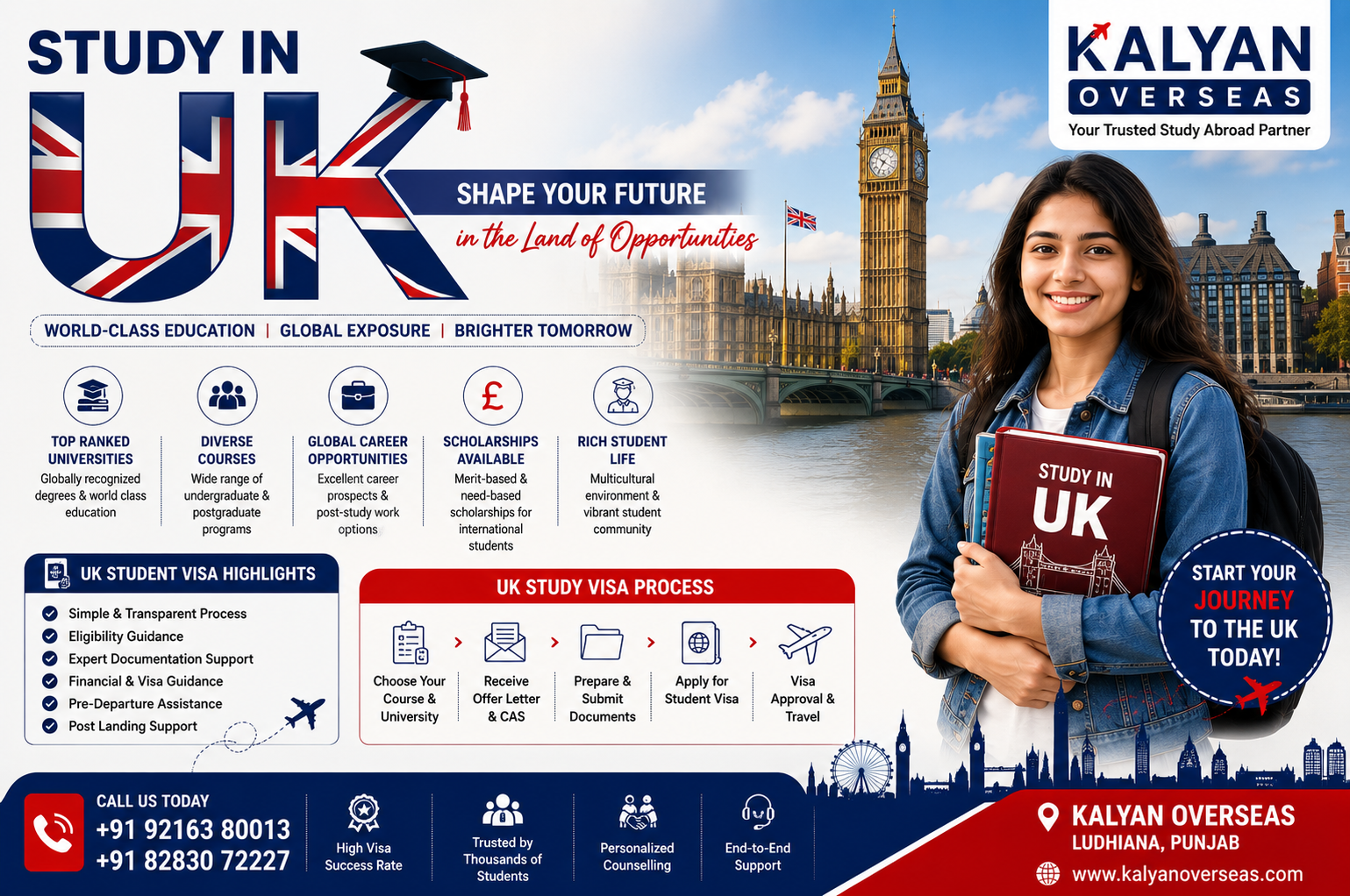
UK Study Visa 2026: A Practical Guide for Students Planning Their Education in Britain
UK Study Visa 2026: A Practical Guide for Students Planning Their Education in Britain
Planning to study in the UK from India? Getting admission is only one part of the journey. Your course choice, university sponsorship, Confirmation of Acceptance for Studies (CAS), finances, English-language evidence and visa documentation all need to fit together before you submit your Student visa application.
For students from Punjab and across India, the UK remains an attractive destination for internationally recognised education, specialised courses and exposure to a global professional environment.
This guide explains the UK Student visa process from the point of planning your education through to preparing your visa application, while highlighting some of the important rules students should understand before making a decision.
What Is the UK Student Visa?
The UK Student visa is the main immigration route for eligible international students who want to study an approved course in the United Kingdom.
To qualify, you generally need an offer from a licensed student sponsor, enough funds to support yourself and pay the required course costs, and evidence that you meet the English-language requirement. The route replaced the former Tier 4 (General) Student visa.
For most Indian students planning a full-time degree or other eligible higher-education course, the Student visa is the route that needs to be considered.
Who Can Apply for a UK Student Visa?
You may be eligible if you:
-
Are 16 or older
-
Have been offered a place on an eligible course
-
Are sponsored by a licensed UK education provider
-
Have a Confirmation of Acceptance for Studies (CAS)
-
Meet the financial requirements
-
Meet the English-language requirements
-
Can provide the documents required for your circumstances
The exact eligibility criteria depend on your course, education provider and personal circumstances.
The Most Important Step: Choosing the Right Course
A strong UK study visa application starts well before the visa form.
Your course should make sense when considered alongside:
-
Your previous academic background
-
Your professional experience
-
Your career objectives
-
Your chosen university
-
Your intended career direction
The UK Student route permits study on specified eligible courses, including qualifying full-time courses below degree level and degree-level or higher courses.
This is why course selection should not be based only on tuition fees or the popularity of a subject.
A course should have a clear academic and career rationale.
What Is a CAS?
The Confirmation of Acceptance for Studies (CAS) is a reference issued by your education provider after you have been offered a place and the university or college is ready to sponsor your Student visa application.
You need your CAS before applying for the Student visa.
Your CAS contains important information about your course and sponsorship, so students should carefully check the details before submitting their visa application.
UK Student Visa Requirements
Your document checklist will depend on your circumstances, but the UK government states that applicants must provide a current passport or valid travel document and their CAS.
You may also need:
-
Financial evidence
-
Academic documents
-
English-language evidence
-
TB test results, where applicable
-
ATAS certificate, where applicable
-
Sponsorship evidence, where applicable
-
Parental consent and relationship evidence if you are under 18
Additional documents can be required depending on your individual situation.
Financial Requirement for a UK Student Visa
Financial planning is one of the areas students should prepare carefully.
You generally need to show that you can pay your required course fees and support yourself financially in the UK.
The current maintenance requirement is:
Studying in London
£1,529 per month, for up to 9 months.
Studying outside London
£1,171 per month, for up to 9 months.
The course-fee amount is based on the information shown on your CAS.
The rules around acceptable financial evidence are specific. For example, qualifying personal, parental or partner funds may be used in appropriate circumstances, and the required funds generally need to have been held for the required period.
Important: Students should always check the latest UK government financial rules before submitting an application because immigration requirements can change.
English Language Requirement
You must normally demonstrate the required level of English for your Student visa unless you qualify for an exemption or another permitted method of proving English ability.
Depending on your circumstances, English may be demonstrated through:
-
An approved English-language test
-
Certain UK qualifications
-
Certain overseas qualifications taught in English
-
Other accepted evidence
For a degree-level course, the required standard is determined under the Student route rules and your education provider's admission requirements may also apply.
This is where students should avoid assuming that one English test automatically works for every university or course.
IELTS, PTE, Duolingo and other English-language options should be checked against the specific university and course requirements before application.
Do Indian Students Need a TB Test?
If you are coming to the UK for six months or more and meet the conditions for the TB testing requirement, you need a tuberculosis test from a clinic approved by the UK Home Office.
The UK government specifically lists India among the countries where applicants may need testing, depending on the relevant residence conditions.
Approved testing locations in India include clinics in cities such as Ludhiana, Chandigarh, Bathinda, Delhi, Mumbai and other locations.
This makes it particularly important for students from Punjab to check the approved-clinic list before arranging their medical appointment.
UK Student Visa Application Process
The process can be understood in a few major stages.
Step 1: Profile Assessment
Review your academic history, English-language ability, budget and career plans.
Step 2: Course and University Selection
Shortlist suitable UK institutions and courses according to your profile.
Step 3: University Application
Submit the required academic and supporting documents to the institution.
Step 4: Receive Your Offer
The university may issue a conditional or unconditional offer depending on your circumstances.
Step 5: Meet the Conditions
Complete any outstanding requirements, such as academic documents, English-language requirements or fee payments.
Step 6: Receive Your CAS
Your university issues the Confirmation of Acceptance for Studies when the relevant sponsorship process is complete.
Step 7: Prepare Your Visa Evidence
Arrange your passport, financial evidence, TB certificate where required, and other applicable documents.
Step 8: Submit the Student Visa Application
Student visa applications are submitted online. You will be told whether you need to use the UK Immigration: ID Check app or attend a visa application centre to provide biometrics.
Step 9: Wait for the Decision
For applications made outside the UK, the usual processing time is around 3 weeks, although actual processing can vary.
How Much Does a UK Student Visa Cost?
As of the current UK government guidance, the Student visa application fee is:
£558
This applies to applications made from outside the UK and to applications to extend or switch to the Student route from inside the UK, subject to the applicable rules.
Students must also pay the applicable Immigration Health Surcharge (IHS) as part of the immigration process. The amount depends on the length and circumstances of the visa.
When Should You Apply for a UK Student Visa?
Students applying from outside the UK can generally submit their Student visa application up to 6 months before the course start date.
Planning early is useful because it gives you time to:
-
Complete university applications
-
Meet offer conditions
-
Arrange finances
-
Obtain your CAS
-
Complete your TB test if required
-
Prepare the visa application carefully
Can You Work While Studying in the UK?
Some Student visa holders are allowed to work, but the permitted amount and type of work depend on factors such as the course and the education provider.
The Student route does not give everyone unlimited work rights. Certain types of work are prohibited, including self-employment and professional sport-related roles.
Therefore, students should check the specific work conditions attached to their immigration permission rather than relying on general information found online.
Can Students Take Their Family to the UK?
Dependant rules have become more restrictive.
In general, dependants may be permitted in specific situations, such as certain government-sponsored students or students undertaking eligible postgraduate research programmes.
For postgraduate courses starting on or after 1 January 2024, the relevant course generally needs to be a PhD/doctoral programme or another qualifying research-based higher degree.
This is an important point for married students and students planning to bring children to the UK.
What Happens After Graduation?
The UK offers a separate Graduate visa route for eligible students who successfully complete an eligible course.
However, students planning their long-term future should pay attention to the latest rules.
For applications made on or before 31 December 2026, the Graduate visa generally lasts 2 years for eligible non-doctoral graduates.
For applications made on or after 1 January 2027, the period for eligible non-doctoral graduates is scheduled to reduce to 18 months.
PhD and other doctoral graduates can receive a 3-year Graduate visa.
This means students should consider current immigration rules when planning their education and career pathway rather than assuming that today's post-study rules will remain unchanged.
Common Mistakes Students Make in UK Visa Applications
A good application is not simply about submitting a large number of documents.
Common areas that require attention include:
Choosing a Course Without a Clear Reason
Your course selection should make academic and professional sense.
Treating Financial Evidence as an Afterthought
Funds must meet the specific requirements rather than simply showing a large balance on the day of application.
Ignoring University-Specific Requirements
Admission requirements and visa requirements are not always identical.
Using Outdated Visa Information
UK immigration rules change. Information from an old blog or social media post may no longer apply.
Inconsistent Information
Your academic history, application, financial documents and other evidence should be accurate and consistent.
Waiting Until the Last Moment
Delays in documents, university conditions, CAS issuance or visa preparation can affect your timeline.
UK Study Visa for Students from Ludhiana and Punjab
Students from Ludhiana and across Punjab have access to a wide range of UK education options, from undergraduate programmes to postgraduate and specialised courses.
For students considering the UK from Punjab, the process can involve several stages:
Profile Assessment → Course Selection → University Application → Offer → Conditions → CAS → Financial Preparation → Visa Application
Getting professional guidance can help students understand which parts of the process apply to their individual profile.
Why Choose Kalyan Overseas for UK Study Visa Assistance?
Kalyan Overseas, Ludhiana, provides guidance to students planning their UK education journey.
Our support can include:
-
Student Profile Assessment
-
Course and University Guidance
-
Admission Assistance
-
Application Documentation
-
SOP Guidance
-
CAS Preparation Support
-
Financial Documentation Guidance
-
Student Visa Assistance
-
Pre-Departure Guidance
Our objective is to help students make informed decisions instead of simply applying for a course without considering the wider academic and career pathway.
Frequently Asked Questions About UK Study Visa
How much does a UK Student visa cost?
The current Student visa application fee is £558, with the applicable Immigration Health Surcharge payable separately.
How early can I apply for a UK Student visa?
Students applying from outside the UK can generally apply up to 6 months before their course begins.
What is a CAS for a UK Student visa?
CAS stands for Confirmation of Acceptance for Studies. It is issued by your licensed education provider and is required before you apply for a Student visa.
How much money do I need for a UK Student visa?
The current maintenance requirement is £1,529 per month for London or £1,171 per month outside London, for up to 9 months, in addition to the required course-fee amount.
Do Indian students need a TB test for the UK?
Students coming from India for six months or more generally need to check the TB testing requirement. Where required, the test must be completed at an approved clinic.
Can I work while studying in the UK?
Some Student visa holders can work, but the permitted hours and conditions depend on the course and circumstances. Certain types of work are prohibited.
Can I take my spouse to the UK on a Student visa?
Only certain Student visa holders can bring dependants. The rules are particularly restrictive for postgraduate courses beginning from 1 January 2024.
How long can I stay in the UK after completing my degree?
Eligible graduates can apply for a Graduate visa. The duration is currently 2 years for applications made by 31 December 2026 and is scheduled to be 18 months for applications made from 1 January 2027, while eligible doctoral graduates can receive 3 years.
Start Your UK Education Journey with Kalyan Overseas
Choosing the UK is a major academic and financial decision. The right course, university, documentation and visa preparation can make the process much easier to manage.
If you're planning to study in the UK from Ludhiana or anywhere in Punjab, Kalyan Overseas can help you understand your options and prepare for the admission and Student visa journey.
Let's Talk
???? +91 92163 80013
???? +91 82830 72227
Kalyan Overseas – Helping Students Plan Their International Education Journey.